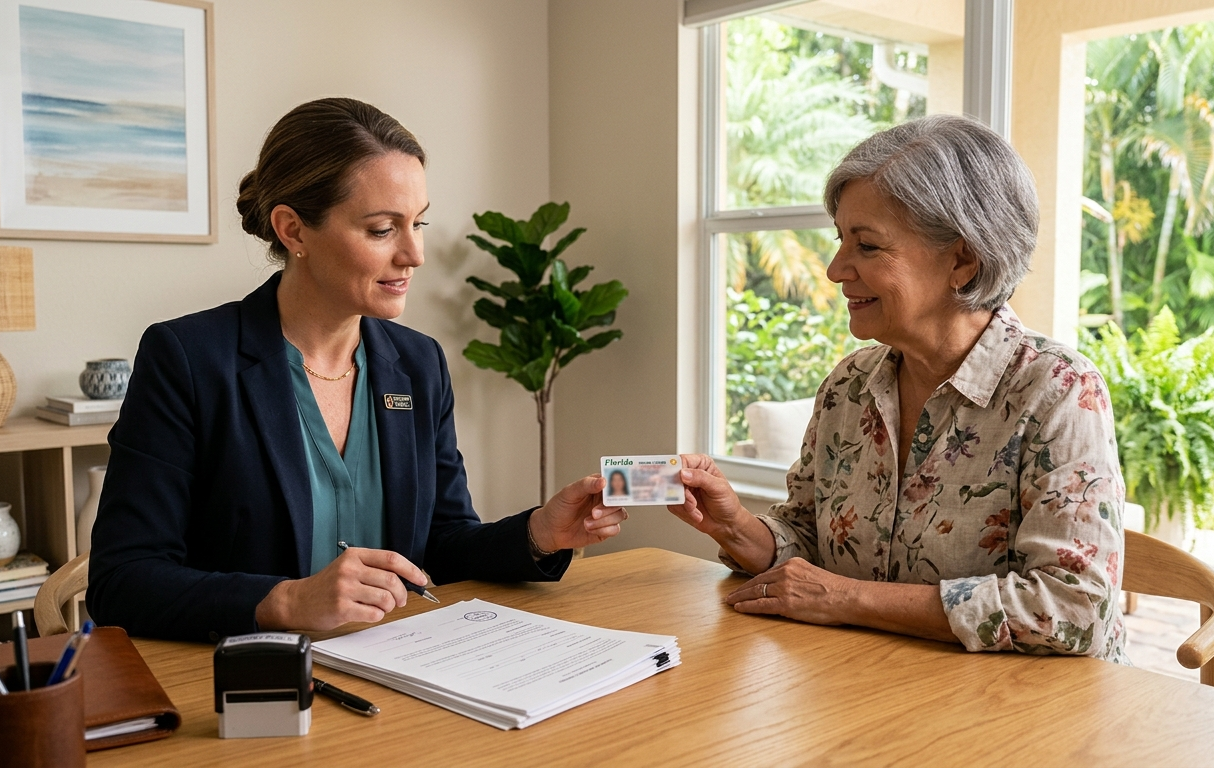
One of the most common reasons a Florida notarization gets delayed or derailed has nothing to do with the document itself. It comes down to identification. The signer shows up without the right ID, or with an expired one, and the appointment cannot proceed. For residents in Stuart, Hobe Sound, and Port Salerno who have scheduled a mobile notary appointment, understanding valid ID for a Florida notarization in advance saves everyone time and prevents a frustrating last-minute scramble.
Florida law is clear about what counts as acceptable identification for a notarization. This guide explains every accepted form of valid ID for a Florida notarization, what to do when standard ID is unavailable, and why getting this detail right matters just as much as having the document ready.
Table of Contents
Why Valid ID for a Florida Notarization Is Required
A notary public’s core function is to serve as an impartial witness who verifies the identity of the person signing a document. That identity verification is the foundation of everything the notarial act accomplishes. When a notary applies their seal, they are certifying that the person who signed is who they say they are.
Without confirming a valid ID for a Florida notarization, that certification is meaningless. It is also why Florida law places the identity verification requirement on the notary directly. If a notary fails to properly verify identity and a fraudulent signing occurs, the consequences can be serious for everyone involved, including the notary.
For Martin County residents signing important documents like a durable power of attorney, a real estate deed, or an affidavit, the identity verification step is not a formality. It is a legal requirement that protects the signer, the notary, and anyone relying on the document later.
The Primary Forms of Valid ID for a Florida Notarization
Florida Statute 117.05 outlines exactly what qualifies as acceptable identification for notarization purposes. The following documents are the primary forms of valid ID for a Florida notarization.
Florida Driver’s License or Florida ID Card
A Florida driver’s license or state-issued identification card is the most commonly presented form of valid ID for a Florida notarization. Both are issued by the Florida Department of Highway Safety and Motor Vehicles, include a photograph, and are widely accepted.
The ID must be current and unexpired. An expired Florida driver’s license does not qualify as valid ID for a Florida notarization, even if the photograph and information are still accurate. This catches people off guard more often than expected, particularly seniors who no longer drive and may not have renewed their license in years.
United States Passport or Passport Card
A U.S. passport book or passport card is universally accepted as valid ID for a Florida notarization. Both are government-issued, photograph-bearing documents that meet Florida’s requirements. For residents who do not have a current driver’s license, a valid passport is the most reliable alternative.
Passports do have expiration dates. A U.S. passport is generally valid for ten years for adults. Confirming the passport is not expired before the notary appointment is worth a quick check.
Out-of-State Driver’s License
A driver’s license issued by another U.S. state is accepted as valid ID for a Florida notarization, provided it is current, contains a photograph, and has a physical description of the holder. This is particularly relevant for Martin County’s large snowbird population. Seasonal residents from New York, Ohio, Michigan, and other states who maintain a driver’s license from their home state can use it for notarizations in Florida.
For more on how seasonal residents navigate Florida notarization requirements, the post on mobile notary services in Stuart, Florida covers the full appointment process from scheduling through signing.
Military Identification Card
A valid military ID card issued by the United States Department of Defense qualifies as a valid ID for a Florida notarization. Active duty service members, reservists, and dependents holding a current military ID can present it at a notary appointment.
Permanent Resident Card (Green Card)
A U.S. Permanent Resident Card issued by the Department of Homeland Security is accepted as valid ID for a Florida notarization. The card must be current. Permanent residents without a Florida driver’s license can rely on their green card to meet the identification requirement.
Foreign Passport
A passport issued by a foreign government is accepted as valid ID for a Florida notarization, provided it contains a photograph and a physical description of the holder. This is relevant for international residents, recent immigrants, and visitors who need documents notarized while in Martin County. A foreign passport does not need to have a U.S. visa stamp to qualify, though the notary may note the identification details in their journal.
What Does Not Count as Valid ID for a Florida Notarization
Understanding what is not accepted is just as important as knowing what is. The following are commonly presented at notary appointments, but do not meet Florida’s requirements for valid ID for a Florida notarization.
Social Security cards contain a name but no photograph and no physical description. They do not qualify.
Birth certificates are not acceptable on their own. They contain no photograph and can easily be obtained by someone other than the named individual.
Medicare or Medicaid cards are insurance documents, not government-issued identity documents with photographs.
Credit cards and debit cards, even those with a name embossed, do not qualify as valid ID for a Florida notarization.
Expired government-issued IDs of any kind, including expired passports and expired driver’s licenses, do not meet the requirement regardless of how recently they expired.
Voter registration cards are not photo IDs and do not meet Florida’s standard.
This is one of the more common stumbling blocks in notary appointments across Martin County, and it is one of the reasons banks frequently decline to notarize documents when the only ID a customer has is something other than a current, government-issued photo ID.
What Happens When a Signer Does Not Have Standard Valid ID for a Florida Notarization
Not every signer has a current driver’s license or passport readily available. Emergency hospital admissions, seniors who have not renewed their license, and individuals whose ID was lost or stolen can all find themselves without a standard, valid ID for a Florida notarization when it is needed most.
Florida law provides two alternative identification methods for exactly these situations.
Identification by a Credible Witness
When a signer cannot produce a standard, valid ID for a Florida notarization, Florida Statute 117.05 allows identification through a credible witness. A credible witness is someone the notary personally knows, or someone who can provide their own valid ID to the notary, who swears under oath that they personally know the signer and that the signer is who they claim to be.
The credible witness takes an oath administered by the notary and signs the notary’s journal. This method places legal responsibility on the credible witness and the notary, so both parties must be confident in the identification before proceeding.
This option is particularly useful in hospital and assisted living settings throughout Martin County, where a family member who is personally known to the notary, or who can provide their own valid ID, can vouch for a patient who does not have identification present. For more on notarizations in these settings, the post on mobile notary services for seniors in Martin County covers the logistics in detail.
Identification by Two Credible Witnesses
If the notary does not personally know the credible witness, two credible witnesses can be used instead of one. Both witnesses must provide a valid ID to the notary, and both must personally know the signer. Both swear under oath and sign the notary’s journal.
This two-witness method provides a higher level of verification and is accepted in situations where standard ID and a single credible witness are both unavailable. It requires more coordination before the appointment, so this situation should be discussed with the notary when scheduling.
Special Situations That Come Up in Martin County
Seniors With Expired Licenses
This situation comes up regularly throughout Hobe Sound, Stuart, and Port Salerno. A senior stopped driving years ago, their license expired, and they never obtained a Florida ID card as a replacement. When a notarization is needed, an expired license is not a valid ID for a Florida notarization.
The practical solution is to obtain a Florida ID card from the Florida Department of Highway Safety and Motor Vehicles before the appointment. Florida ID cards are inexpensive and available at driver’s license service centers. For seniors who cannot travel to a service center, a family member or caregiver can assist with the process. Alternatively, if a valid U.S. passport exists, it can be used in place of the driver’s license.
Hospital and Emergency Situations
Patients admitted to Cleveland Clinic Martin North in Stuart or Cleveland Clinic Martin South in Hobe Sound during an emergency often do not have their wallet or ID with them. This is one of the most common challenges in hospital notarizations throughout Martin County.
The credible witness procedure described above is frequently used in these situations. A family member who personally knows the patient and can present their own valid ID to the notary can vouch for the patient’s identity. This should be discussed when scheduling the appointment so the notary can prepare accordingly.
The full process for hospital notarizations in Martin County is covered in the post on hospital notarizations in Stuart, Hobe Sound, and Port Salerno.
Signers With Foreign Documents Only
International residents or visitors who hold only a foreign passport should confirm it is current and contains both a photograph and a physical description before the appointment. Most modern foreign passports meet these requirements. If there is any question about whether a specific foreign passport qualifies as valid ID for a Florida notarization, it is worth asking when scheduling the appointment.
Estate Signings With Multiple Signers
When multiple family members are signing documents together, such as a durable power of attorney, a living will, or documents requiring witnesses, each person present who is signing must have their own valid ID for a Florida notarization. The witnesses to a signing are not exempt from identity verification simply because they are not the principal signer. Understanding which documents require witnesses in Florida helps families prepare everyone present with appropriate identification before the appointment.
Practical Tips for Martin County Residents Before a Notary Appointment
Check expiration dates before the appointment. Pull out the ID that will be presented and confirm the expiration date. An expired ID, even one that expired recently, is not a valid ID for a Florida notarization and cannot be accepted regardless of how well-known the signer is to the notary.
Do not rely on documents without photographs. Social security cards, birth certificates, and insurance cards are frequently offered at notary appointments. None of them qualifies as a valid ID for a Florida notarization. A photograph is a non-negotiable element of acceptable identification.
Bring the ID to the appointment location. For home appointments in Stuart or Hobe Sound, the ID should be at the signing location before the notary arrives. For hospital appointments, confirming ID availability when scheduling prevents a last-minute delay at the bedside.
Notify the notary in advance if ID is unavailable. If a signer does not have a qualifying ID, notifying Treasure Coast Notary Service at the time of scheduling allows time to plan for the credible witness procedure. Waiting until the appointment begins to raise this issue creates delays and may require rescheduling.
Keep ID current even after stopping driving. A Florida ID card is the simplest way to maintain a valid government-issued photo ID without a driver’s license. It meets the requirements for a valid ID for a Florida notarization and is inexpensive to obtain and renew.
How This Fits Into a Smooth Notary Appointment
Confirming a valid ID for a Florida notarization is just one part of preparing for a smooth signing. The other key elements are having the document complete with no blank spaces, arranging required witnesses in advance, and ensuring the signing location is accessible and ready.
For business owners in Martin County managing notarized documents for their operations, the post on notarizing business documents in Florida covers the full preparation process in a commercial context.
Appointments with Treasure Coast Notary Service can be booked online through the Calendly scheduling link on the website, or by calling or texting directly for same-day requests. When scheduling, mentioning any concerns about identification gives the notary time to prepare the right approach before arriving.
Frequently Asked Questions
Can an expired driver’s license be used as a valid ID for a Florida notarization? No. An expired driver’s license does not meet the requirement for a valid ID for a Florida notarization under Florida law, regardless of how recently it expired.
Does a foreign passport count as valid ID for a Florida notarization? Yes, provided the passport contains a photograph and a physical description of the holder and has not expired.
What if I only have a Social Security card and a birth certificate? Neither qualifies as a valid ID for a Florida notarization on its own. A credible witness procedure may be available depending on the circumstances. This should be discussed with the notary when scheduling.
Can a notary look up my ID in a database to verify it? Florida notaries verify identity through physical inspection of the presented document. They are not required to access government databases, though some notary platforms used for online notarization do perform electronic identity verification.
Does every person present at a signing need to show a valid ID for a Florida notarization? Anyone who is signing a document or swearing an oath in the notary’s presence must present identification. Witnesses who sign documents but are not swearing an oath may or may not be required to present ID, depending on the specific document and notarial act involved.
How quickly can an appointment be scheduled in Martin County? Same-day and next-day appointments are frequently available throughout Stuart, Hobe Sound, Port Salerno, Palm City, and Jensen Beach. Book online through the Calendly scheduling link or call and text directly for urgent requests.
Treasure Coast Notary Service provides mobile notarization throughout Martin County, including Stuart, Hobe Sound, Port Salerno, Jupiter Island, Tequesta, and Jupiter. To schedule an appointment, book online or call and text directly at 561-545-7278.


Leave a Reply